Understanding Homeopathic Potency Scales: 6X, 30C, LM, and Other Systems Explained
If you’re exploring Jackson’s Cell Salts or other homeopathic remedies, you may notice that products are labeled with potencies such as 6X, 30C, or 200C. These letters and numbers refer to the dilution scale and preparation method used when making a remedy.
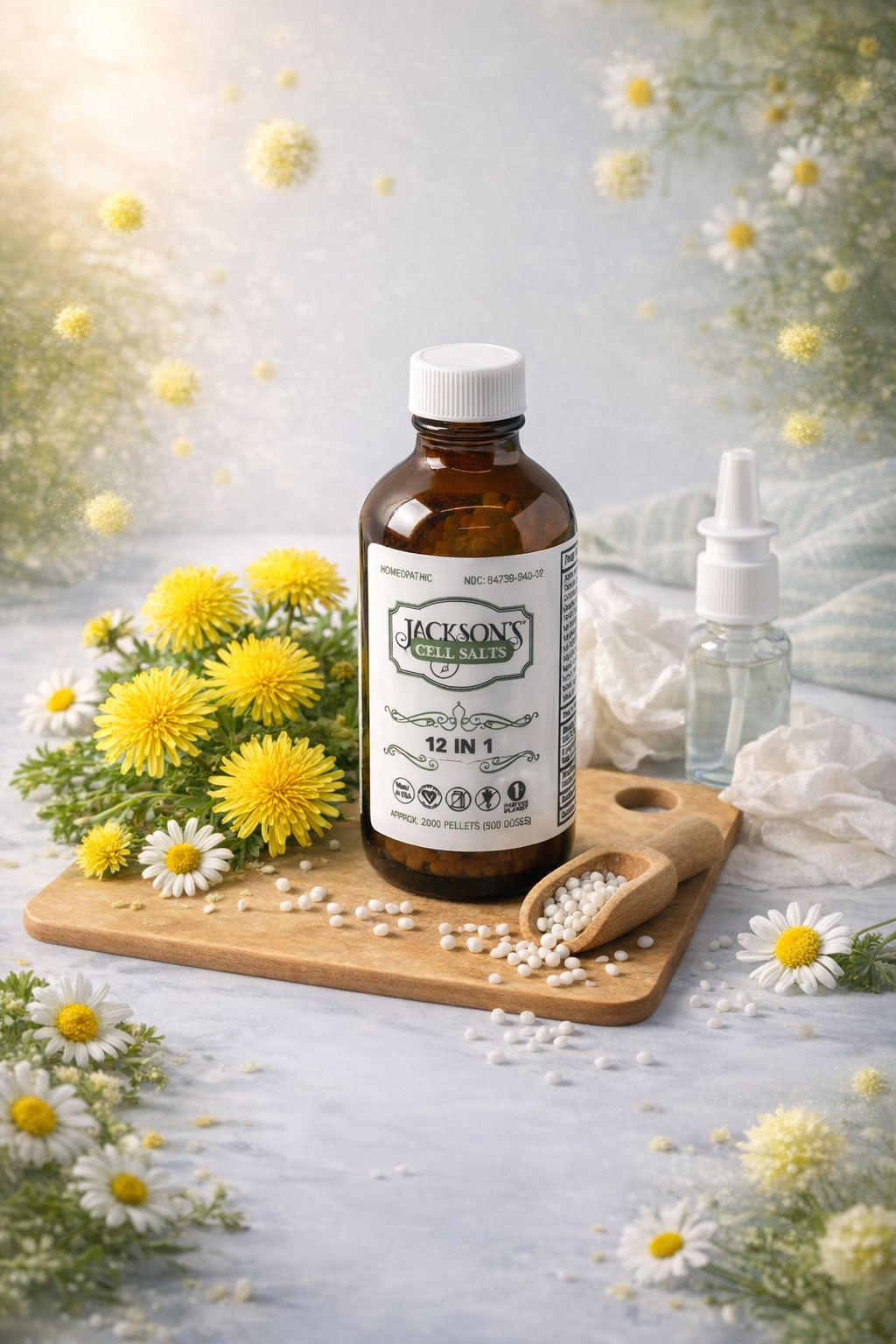
At Jackson’s Naturals, all of our cell salts are prepared in 6X potency, which is the traditional potency used in the biochemical tissue (cell) salt system developed by Dr. Wilhelm Heinrich Schuessler.
To better understand why these potency numbers exist—and why different scales are used—it helps to look at both the preparation methods and a bit of the history of homeopathy.
What Do Potency Numbers Mean?
In homeopathy, remedies are prepared through a process called serial dilution and succussion (vigorous shaking) or trituration (grinding with the non-active base ingredient).
Each step dilutes the original substance and is believed in homeopathic theory to activate or “potentize” the preparation.
Two parts of the potency label describe how this preparation was done:
• The number indicates how many dilution steps have occurred.
• The letter indicates the ratio of dilution used at each step.
For example:
• 6X means six dilution steps using the decimal scale.
• 30C means thirty dilution steps using the centesimal scale.
A Brief Historical Note
When Samuel Hahnemann, the founder of homeopathy, began experimenting with remedies in the late 1700s, he initially used substances in their crude form.
Many of these substances—such as mercury, arsenic, or belladonna—could produce strong toxic effects. In an effort to reduce these unwanted effects while still observing therapeutic responses, Hahnemann began diluting remedies step by step.
During these experiments he observed that remedies appeared to remain active even after repeated dilution, especially when they were vigorously shaken between steps. This process eventually became known as potentization.
Over time, homeopaths developed standardized dilution systems, which became known as potency scales.
The Decimal Scale (X or D)
The X scale (also called the D scale) uses a 1:10 dilution ratio.
This means each step contains:
• 1 part original substance
• 9 parts diluent (traditionally lactose or sucrose for pellets, and alcohol/water for liquid preparations)
After each step, the mixture is succussed or triturated before continuing to the next dilution.
Example: Preparing a 6X Remedy
1 part original substance + 9 parts lactose or sucrose → 1X
1 part of the 1X mixture + 9 parts lactose or sucrose → 2X
Continue this process until reaching 6X
Schuessler cell salts are traditionally prepared using this decimal scale.
The Centesimal Scale (C or CH)
The C scale (sometimes written CH) uses a 1:100 dilution ratio.
Each step contains:
• 1 part substance
• 99 parts diluent
Because the dilution step is larger, the potency numbers in the centesimal scale often appear higher.
These comparisons are very rough approximations based purely on dilution ratios. In practice, remedies prepared using different scales are not considered directly interchangeable, since the preparation methods differ.
Why Schuessler Cell Salts Use 6X
Dr. Wilhelm Heinrich Schuessler developed the biochemical cell salt system in the late 1800s using low decimal potencies, most commonly 6X.
His approach focused on supplying the body with micro-doses of mineral salts that correspond to those naturally present in human tissues.
Because of this philosophy, the tissue salt system evolved somewhat separately from classical homeopathy, even though the preparation methods share similarities.
Most manufacturers of cell salts—including Jackson’s Naturals—continue to prepare them in 6X potency, following the guidelines found in the Homeopathic Pharmacopoeia of the United States (HPUS).
Early practitioners, including Schuessler and Hahnemann, believed lower potencies tended to work more on physical symptoms, whereas higher potencies influenced deeper or systemic patterns.
Trituration: An Important Early Step
For substances that do not dissolve easily, such as minerals or metals, early homeopaths first prepared remedies using trituration.
Trituration involves grinding the substance together with lactose or sucrose powder in a mortar and pestle through several stages of dilution.
After several trituration steps, the material can then be dissolved and further diluted into liquid potencies.
This method is still described in modern homeopathic pharmacopoeias.
Other Less Common Homeopathic Potency Scales
While the X (decimal) and C (centesimal) scales are the most widely used, several other potency systems exist. These systems developed as homeopaths experimented with different methods of dilution and preparation.
LM or Q Potencies
LM potencies, also called Q potencies or 50-millesimal potencies, were introduced later in the development of homeopathy by Samuel Hahnemann in the sixth edition of the Organon of Medicine.
Each step involves an approximate 1:50,000 dilution, combined with a unique method of trituration, dilution, and succussion. Remedies are typically prepared using alcohol and water solutions and are often administered in liquid form.
LM potencies are written as:
• LM1
• LM2
• LM3
or
• Q1
• Q2
• Q3
These potencies allow very gradual adjustments in potency. Interestingly, LM potencies were not widely used for many years because the sixth edition of the Organon was published after Hahnemann’s death and did not become widely circulated until later.
M Potencies
M potencies refer to very high centesimal potencies within the C scale.
The letter M comes from the Roman numeral for 1000, meaning:
1M = 1000C
Examples include:
• 1M (1000C)
• 10M (10,000C)
• 50M (50,000C)
• CM (100,000C)
These high potencies became more common in the late 1800s and early 1900s through practitioners such as James Tyler Kent, who helped popularize their use in classical homeopathic prescribing.
Because these potencies involve extremely large numbers of dilution steps, they are generally prepared by specialized homeopathic pharmacies using carefully standardized methods.
These potencies are not typically used in Schuessler cell salt systems, which traditionally rely on lower decimal potencies such as 6X.
Korsakovian Potencies (K)

Korsakovian potencies, abbreviated with the letter K, represent another approach to preparing high potencies.
This method was developed in the early 19th century by Count Semyon Korsakov, a Russian nobleman who sought a simpler way to prepare remedies requiring many dilution steps.
In most homeopathic systems, each dilution step involves transferring a measured quantity of remedy into a new container with fresh diluent.
The Korsakovian method instead reuses the same container for every dilution step.
The process works roughly like this:
1. A vial is filled with the remedy solution.
2. The vial is emptied.
3. A thin film of liquid remains coating the inside of the container.
4. The vial is refilled with fresh diluent and succussed.
5. This process is repeated for each subsequent potency.
Because a small amount of the previous dilution remains in the vial, each refill effectively produces the next dilution level.
Examples include:
• 30K
• 200K
These potencies are sometimes considered roughly comparable to 30C or 200C, though the preparation method differs significantly.
The Korsakovian technique allowed remedies to be prepared more efficiently, since it eliminated the need for large numbers of separate vials. However, because the exact amount of liquid remaining in the container can vary depending on factors such as surface tension, temperature, and container shape, the dilution steps are less precisely controlled than in standard Hahnemannian methods.
For this reason, the Korsakovian method is used less frequently today but remains an interesting part of the historical development of homeopathic pharmacy.
A Note on Potency Comparisons
It is sometimes tempting to try to convert between potency scales—for example comparing 6X to 3C.
However, these comparisons are approximate at best, because different scales involve:
• different dilution ratios
• different preparation methods
• different usages
For this reason, practitioners typically choose remedies within the same potency system rather than trying to convert between them.
Our Approach at Jackson’s Naturals
At Jackson’s Naturals we prepare all of our cell salts using the 6X decimal potency, which remains the most widely used and historically traditional potency for Schuessler cell salts.
Our pellets are prepared using sucrose rather than lactose, allowing our products to remain suitable for those seeking vegan or lactose-free options while still following traditional homeopathic preparation standards.
This allows us to stay consistent with the original biochemical system developed by Dr. Schuessler and with the preparation standards described in the Homeopathic Pharmacopoeia of the United States (HPUS).